Our Commitment
We care about the future of the Earth. That’s why, many years ago, we at EUROPURE decided to do everything we can to treat water in a way that benefits not only our customers but also the environment.

Our Journey – The Path to a Chemical-Free Solution
In 1997, we had our first contact with water jet cutting systems. At that time, we were approached as specialists by a group of engineers for cooling water circuits from the company Flow Europe to address deficiencies in the water quality of high-pressure pumps. As a result, we developed a first-generation water treatment system for water jet cutting machines.
In close collaboration with the company Bystronic (Switzerland), starting in 2010, we developed a much more compact second-generation water treatment system. Working with Bystronic gave us extensive knowledge about potential water quality issues and their effects on the inner workings of a water jet pump. We continued to work with Bystronic until 2017, when they discontinued the production of water jet cutting systems.
Some problems with water quality long required the use of chemicals, which is why our first- and second-generation systems also used chemicals. The general rethinking – including within our company – as well as stricter environmental regulations and growing customer concerns led us as early as 2010 to use various filtration techniques to reduce the dosing of chemicals.
We invested in R&D and together developed a test station for filter materials, which allowed us to examine most of the filter materials available worldwide for their filtration performance and effects on water quality.
Next-Generation Filter Technology
Filter by definition: a device or apparatus that separates solid substances from liquid or gaseous substances (DUDEN definition of “filter”)
In the next decade, the automotive industry will shift from gas-powered cars to electric (“ion-powered”) cars. Filter technology has already been moving in that direction over the past decade. Advanced filter materials work with ion charges and can specifically trigger reactions to remove unwanted specific contents. These advanced filter materials can change the overall properties of water without adding any chemicals. So, this generation of new filter materials is much more than a filter by definition, and these are exactly the materials we work with.
Sustainability is a big deal for us
That’s why we developed a recycling system for filter materials. 82% of the filter material gets reused!
To get mostly clean water, we use a process known in science as the ‘Advanced Oxidizing Process (AOP)’. In this process, oxygen is the only active substance.
The filter material has a highly porous metallic surface that is preloaded with oxygen ions. This preloading stimulates the production of more ions that react with the water’s impurities. All metallic components as well as a large number of other substances are oxidized and filtered out this way. Over time, the surface of the filter material gets dirty, and the oxidation process stops.
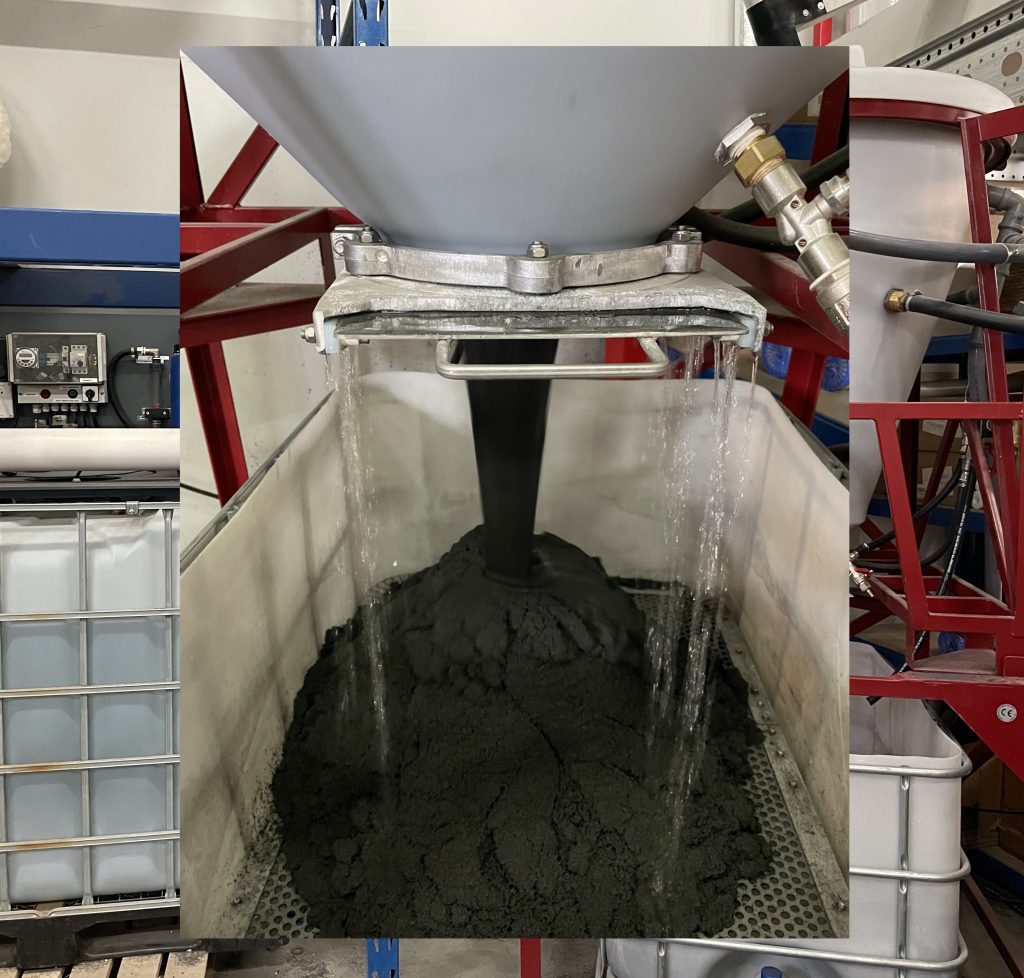
This is how the 3-step regeneration process works:
Cleaning, 30 min.
The filter material is washed thoroughly until its surface is clean.
Disinfection, 10 min.
Regeneration, 60 min.
Preloading with oxygen ions.
Capacity
60 – 80 filter cartridges per 100 minutes
280 – 340 kg per 100 minutes
20% more filter capacity with preloading
Even heavily polluted water becomes crystal clear!